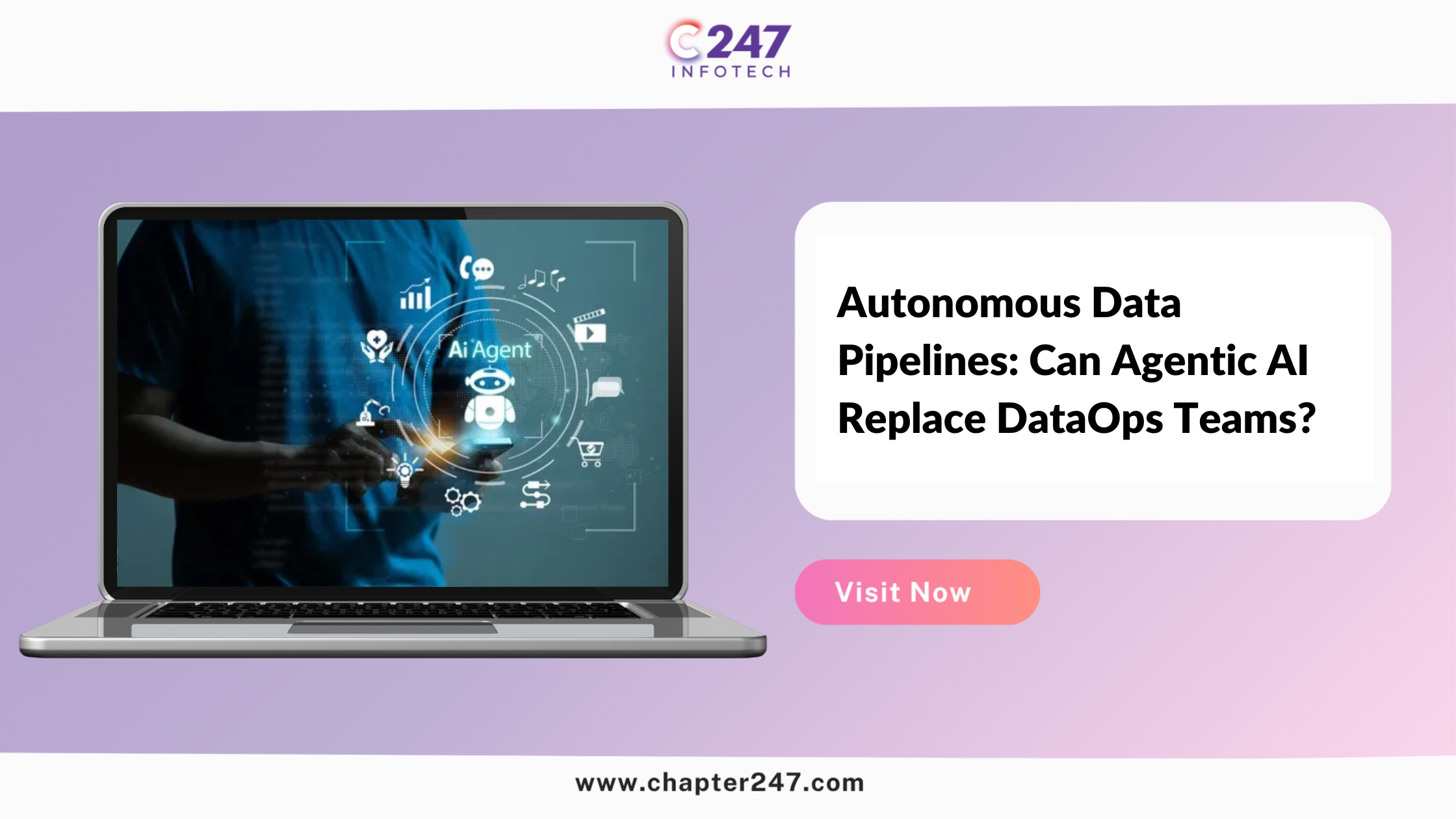
The modern-day business requires rapid, trustworthy, and scalable data processes. Pipelines that are traditional require engineering and human intervention. Such a workflow is fragile and difficult to maintain. An agentic or AI system creates a significant change. They allow pipelines to self-monitor, self-react, and streamline themselves. Autonomous systems are agile, reliable, and have fewer operational frictions.
Business value is already measurable by the early adopters. Research by Capgemini Research Institute shows that companies that scale to AI agents have an average revenue increase of $380 million, which is almost five times higher than those with a low level of adoption. This is a change from reactive automation to proactive intelligence.
Defining an Autonomous Data System
A non-dependence system of data can change without frequent supervision. When the schema or data sources are modified, it automatically reconfigures the workflows. It has self-healing pipeline failures that detect and fix errors at a fast rate. It optimizes queries, transformations, and schedules automatically. It ensures itself by actively enforcing rules of governance and compliance. The contextual awareness is the special component. Conventional automation is governed by fixed principles. Using real-time signals, as well as applied intelligence, the autonomous systems make decisions.
Current Industry Momentum
Studies indicate that there is an increasing use of AI agents in businesses. Firms that have scaled agentic AI record a high revenue increase and productivity. Approximately 61% of organizations regard agency AI as transformative. A quarter of the enterprise processes may be autonomous by 2028. Today, the figure is around 15%. This is indicative of the maturity of technology as well as its acceptance by culture. Companies have started to have confidence in AI-based data processes. This evolution is based on integration platforms and cloud-native tools.
Why Integration Matters?
Any modern data environment is based on integration. Failure to integrate means that all the downstream systems are hit. Dashboards malfunction, models interrupt, and decisions drag. Orchestration manually takes engineering hours and leads to errors. Business logic is difficult to maintain and scale. Businesses waste valuable time rectifying failures. Autonomous data systems address this by starting with integration. AI agents simplify data ingestion, transformation, and orchestration. They reduce failure risk and restore trust in data pipelines.
From Automation to Agentic Intelligence
Automation alone cannot handle today’s complex data environments. Scripts and static workflows lack flexibility under rapid changes. Agentic AI introduces reasoning, planning, and independent execution. Pipelines no longer require manual reconfiguration. AI agents act on goals and contextual information. They collaborate as multiple specialized agents for design, validation, and repair. This is agentic intelligence in practice. It marks a departure from simple automation. Data engineering becomes more adaptive and resilient.
Practical Applications Already Emerging
The promise of autonomous pipelines is not distant theory. Natural language can already generate full integration workflows. A simple prompt creates ingestion, transformation, and scheduling automatically. When failures occur, AI systems detect schema changes. They propose fixes and allow one-click redeployment. AI agents also optimize queries for faster execution. They suggest improvements and highlight them for review. These examples cut engineering hours significantly. Teams can focus on architecture and insights instead.
The Role of Human Engineers
A critical truth remains: humans are essential to data systems. Engineers provide domain knowledge and business context. They validate changes and oversee architecture. AI agents complement this expertise by handling repetitive operations. This human-in-the-loop model strengthens reliability and governance. Engineers train the system with feedback. Over time, agents learn to perform more independently. The collaboration increases both speed and accuracy. Organizations benefit from the combined strengths of humans and AI.
Can AI Replace DataOps Teams?
The question is not whether AI eliminates DataOps teams. Instead, the question is how responsibilities evolve. DataOps has always ensured pipeline reliability, scalability, and trust. Autonomous pipelines reduce manual workload but do not erase strategic needs. Engineers still oversee security, governance, and architectural design. They also focus on innovation and scaling new capabilities. AI agents take over repetitive failures, optimizations, and pipeline generation. Together, they create a stronger data engineering function. Replacement is unlikely, but augmentation is certain.
The Competitive Advantage of Early Adoption
Enterprises adopting agentic AI pipelines report outsized gains. Faster data availability drives stronger decision-making. Automated optimization reduces cost and resource consumption. Reliability improves trust across the organization. Early adopters capture the most benefits. Waiting risks falling behind competitors. As systems mature, adoption will shift from optional to essential. Organizations that move now will lead in efficiency and innovation. Agentic AI adoption is therefore a strategic imperative.
Conclusion
Agentic AI is reshaping data pipelines with autonomy and intelligence. The future is about collaboration, not replacement. DataOps teams and AI agents together will drive reliable insights. Enterprises adopting this hybrid approach will gain lasting advantages. Partnering with experts accelerates this transformation. Chapter247 helps organizations build intelligent, future-ready data systems today.