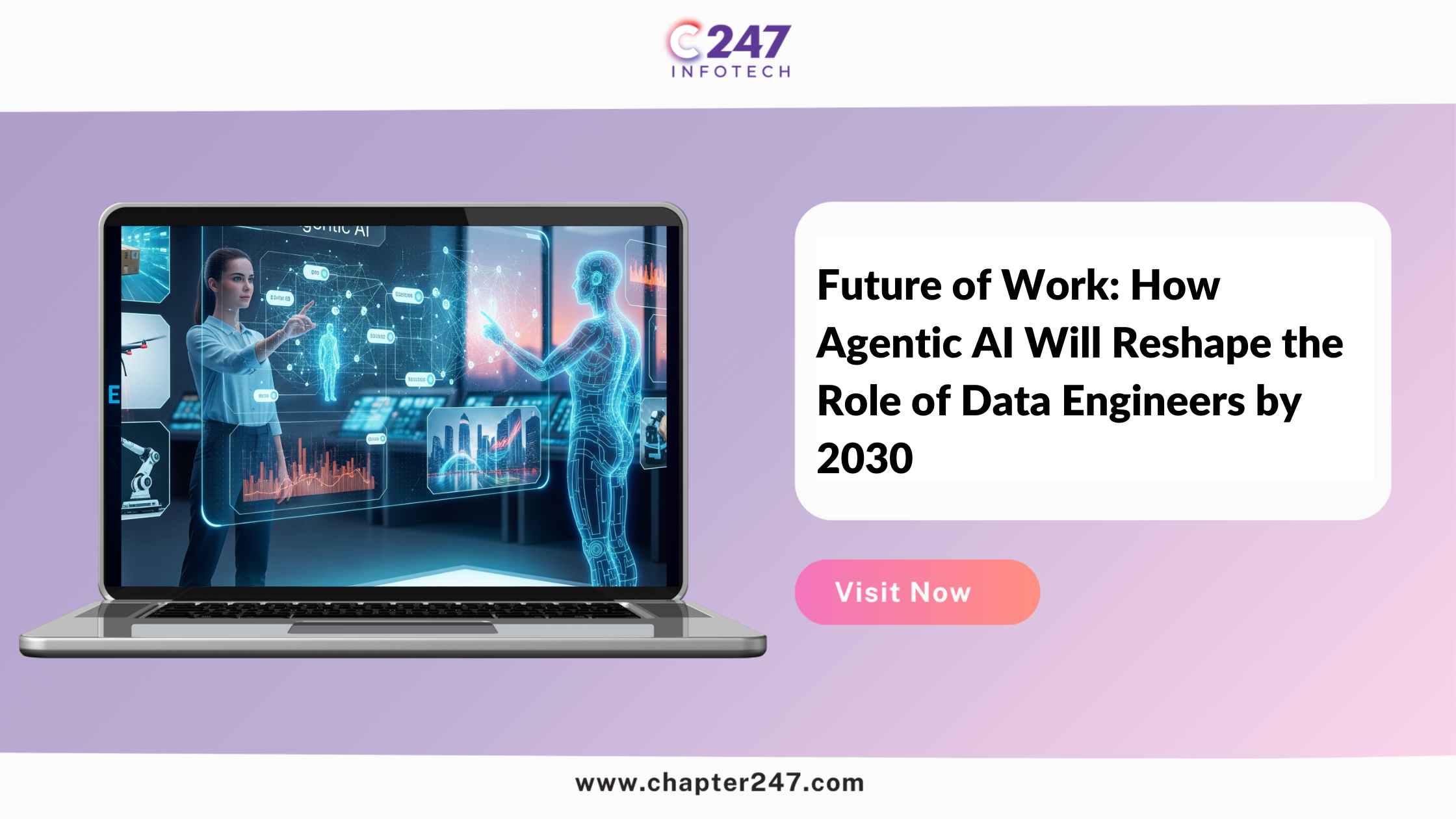
By 2030, the scenery of data engineering will be nearly unrecognisable. Recent research indicates that as much as 30% of working hours throughout the American economy might be put on a robot in the next ten years. This change will require a major push of agentic AI systems, which have the ability to take action independently, learn through feedback, and optimize processes in real time. To data engineers, this change will not be a loss of redundancy but an invention. They will stop using coding pipelines and start creating intelligent ecosystems that combine automation, ethics, and strategy.
The transformation of the Execution to Strategy
At the beginning of the 2020s, data engineers were primarily recognized because of the creation of data pipelines, handling of ETL processes, and delivering data reliably. In 2030, agentic AI systems will have automated practically all of those repetitive tasks. Such systems will code, debug, and optimize code whilst taking care of adherence to global data regulations.
Consequently, data engineers will cease to perform and strategize. Their new purpose will be to determine the interactions between the AI models and business data and make sure that such systems operate ethically and openly. They will not be technical efficiency specialists, but strategic architects, who will match the AI-based data systems with the company objectives and customer value.
The Next Level of Automation: Agency AI
Unlike traditional automation, agentic AI is capable of learning, adapting, and making decisions. This translates to the fact that in a data engineering setting, AI will be able to autonomously operate data pipelines, identify anomalies, and streamline workflows without having to be regularly checked by a human.
Consider an artificial intelligence servant who will watch the quality of data and identify biases, or can anticipate when infrastructure must scale. This type of system would be able to resolve problems immediately or propose measures, and the data reliability and operational stability will be ensured. These AI agents will be monitored by data engineers who will train them, improve their functioning, and establish considerations on ethical decision-making.
This dynamic collaboration between human control and AI initiative will establish a smart feedback mechanism, which will produce innovation, enhance governance, and lessen downtime.
Constructing Smart Data Architectures
By 2030, managing individual pipelines will be replaced by coordinating the whole AI-driven environment. Data engineers will play the role of the conductors of the connected systems so that various AI tools, platforms, and data environments can collaborate with each other seamlessly.
All automated data ingestion and enrichment, real-time analytics, and constant monitoring will be managed by these ecosystems. Semantic layers powered by AI will automatically draw context to data to help organizations discover insights at a faster pace. It implies that engineers will not have to waste hours defining the schemas or resolving the inconsistencies; AI agents will handle those issues, and human beings will work on optimization and interpretation.
Ethical Leadership and Strategic Leadership
With AI replacing the technical background, data engineers will have increased strategic and moral roles. They will make sure that AI systems are run in a transparent way and in accordance with data protection regulations such as the EU AI Act or GDPR.
The new ethical issues brought about by agentic AI are detection of bias, fairness validation, and accountability tracing. The data engineers will also be required to make sure that AI decisions can be explained to the regulators and other stakeholders. They will outline the ethical systems, manage the automation of compliance, and ensure that all AI-led processes are consistent with organizational and social values.
Pipelines to Business Value
The meaning of value in data engineering will be changed with agentic AI. Data engineers will not only be involved in the maintenance of the infrastructure but have a direct impact on business performance. The analytics with the help of AI will turn the raw data into timely strategic data, which will optimize operations, allow spending less, and improve customer experience.
The data engineers will collaborate with the marketing and finance, and operations departments to ensure that factual information is converted into quantifiable business outcomes. As an illustration, AI has the capability of uncovering new trends among customers, forecasting demand changes, and determining prospects of product enhancement in real time. These outputs will be interpreted and translated by engineers into the larger business strategy.
Conclusion
The agentic AI will change the role of the data engineer by 2030. These smart systems will take the technical base and make it automatic, and this gives the engineers time to look at strategy, ethics, and innovation. The change in the task implementation into leadership will result in a new breed of AI system architects: the professional who can operate between technology and business, and make the world an automated, sustainable place.
Although AI will be needed to manage the mechanics, human judgment would be central to responsible innovation. Those data engineers who accept this change will be integral strategic thinkers who will build the intelligent enterprises of the future.
In Chapter247, we assist companies to leverage AI to create smart data ecosystems and begin preparing for this future.