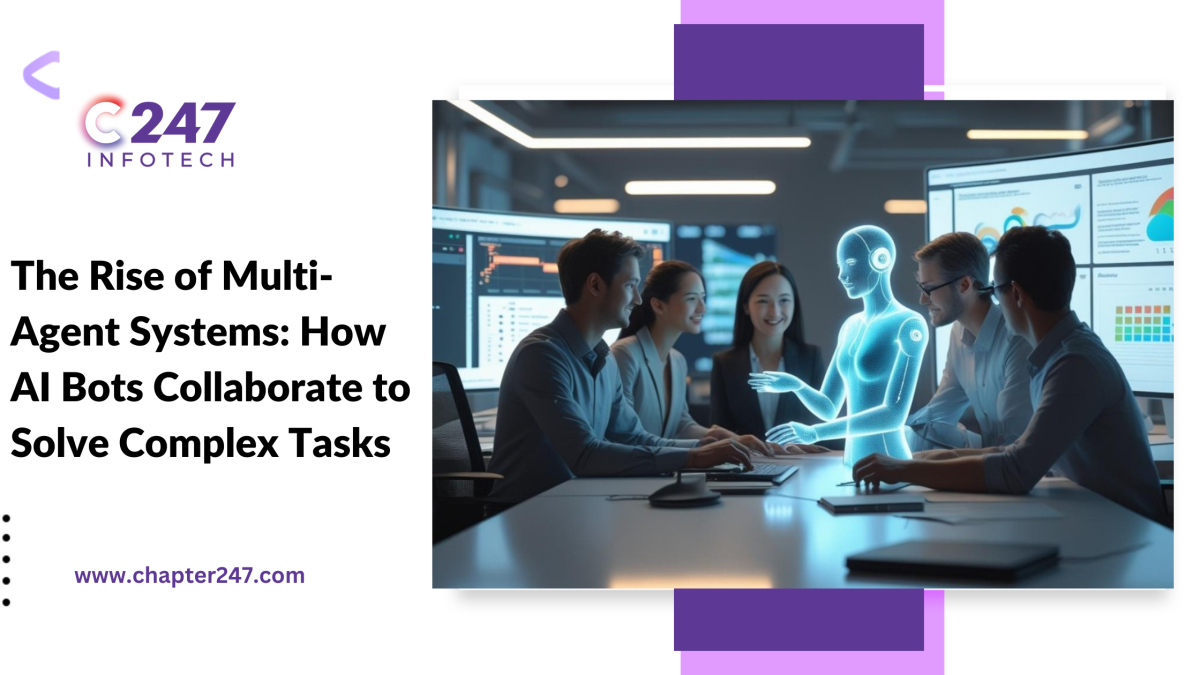
Consider working out complex issues in the workplace. You may require assistance from other professionals. Now, think about those specialists who never get tired. They work 24 hours a day. They can manage a lot of data at once. This includes multi-agent systems and agentic AI. 99% of the 1,000 developers working on AI applications for businesses surveyed by IBM and Morning Consult were either investigating or creating AI agents.
The past AI systems attempted to do everything by themselves. They had problems with complex tasks. Today, we have AIs that collaborate in teams. Both agents are good at one thing. They communicate with one another. When things change, they change.
This is our way of solving problems. We no longer construct one very large system of AI. Instead, we create very small, smart agents. Everyone plays their own game. The result? An enhanced, efficient solution and immediate swiftness, as well as self-educating systems.
The strength of collaboration
Multi-agent systems employ multiple agentic AI agents at the same time. Agents are good at different things. Combined, they can solve greater problems than an agent would have tackled on their own.
Think of a town’s traffic. One agent keeps an eye on the flow of traffic. Still another agent can forecast the likely traffic jams. The third one switches traffic lights. They work together to make the traffic flow better than any one of them alone would make the traffic flow.
What is the Use of Multi-Agent AI?
In the globe, no single model is capable of doing all of this. The multi-agent systems have special benefits:
1. Specialisation and Modularity
Agents deal with different tasks. As an example, some may extract data, some analyse, and others explain it. This reflects the workings of human teams – and increases the precision.
2. Scalability
New functional necessity? A new agent should be added. One does not need to reconstruct the entire system.
3. Resilience
In case of failure of one agent, we can substitute it with another, more tolerant and reliable.
4. Parallelism
It is also possible to have multiple agents working on various subtasks, accelerating various complex workflows.
How Are They beneficial?
Multi-agent systems do not symbolise solely a technical improvement but an obligatory change towards shared wisdom. Division of complex problems into manageable chunks and allocation of specialised agents to each of those chunks opens the possibilities of new efficiencies and abilities.
The emergence of agentic AI symbolises our increasing awareness that the hard problems demand different minds and expertise in the field. AI systems work well when the agents collaborate, similar to human teams that perform optimally when they have varied abilities and opinions.
With these technologies evolving, the multi-agent systems approach will become the dominant one, regardless of how complex the AI application is. The post-pandemic world is the world of AI teams that collaborate, train each other, and evolve according to new challenges, similar to how the most successful human teams do it nowadays.
It is already a transforming process. The organisations that currently adopt multi-agent systems would immediately gain a huge advantage in the future, where agentic AI is the rule and not the exception.
What is the Working of Multi-Agent Systems?
In most of the MAS systems:
- Special agent (Retriever, Summarizer, Analyser)
- A communications system (messages, memory store, blackboard)
- An optional team-coordination controller or orchestrator
- Common tools such as search APIs, databases, or web browsers
Systems such as CrewAI, LangGraph, and AutoGen go further and help the orchestration layer by creating abstractions, making them simpler to create.
Real-World Applications
Nowadays, multi-agent AI is more than just a theory; it spurs actual innovation in real-world applications:
- Healthcare: Agents work together to examine the history of patients, review the research documents, and propose individualised therapy.
- Finance: One tracks live markets, one detects anomalies, and one proposes investment.
- Cybersecurity: The distributed agents perform real-time detection and response to network threats.
- E-Commerce: Agents also optimise the prices, conduct the inventory management, and personalise product suggestions.
- Knowledge Work: The responsibilities, such as document search, filtration, and summarisation, can be divided under Multi-agent systems, which improves Retrieval-Augmented Generation (RAG) pipelines.
Conclusion
This process of moving to multi-agent AI is revolutionary: it is a move towards collaborative intelligence rather than monolithic intelligence. There will no longer be a need for one massive model that is attempting to do everything, but rather we are constructing ecosystems of smaller, specialised agents and managing them as dream teams. The reason for this is that there are situations in which multiple perspectives are superior to one. So, partner with Chapter247 and utilize AI agents to their fullest.