
Digitally Transforming Founder-Led Sessions with Real-Time Data

Client Introduction

The project was initiated to automate, scale, and enrich the founder-led peer learning sessions are organized.

Previously, these sessions relied on manual tracking through slide decks, spreadsheets, and self-reported updates — resulting in inconsistent records, low visibility, and limited data-driven accountability.

The objective was to build a digitally intelligent system that captures, processes, and visualizes the project metrics automatically.

By integrating Typeform, Zapier, SQL databases, and Looker Studio, the platform now delivers a streamlined workflow that automates form delivery, validates attendance, tracks outreach activity, and visualizes engagement metrics in real time — enabling founders and leaders to manage performance effortlessly.

The Requirement

  • Automate Peer Session Management: Build a system that digitizes all manual workflows from session creation to data capture.
  • Digitize Goal and Reflection Tracking: Replace slides with Typeform forms for structured, comparable data across sessions.
  • Establish Centralized Data Storage: Create a secure SQL-based database to house all engagement, attendance, and reflection metrics.
  • Enhance Reporting and Visualization: Provide real-time Looker Studio dashboards for tracking individual and group progress.
  • Promote Accountability and Engagement: Implement gamification tools like leaderboards, streak counters, and engagement scores.
  • Ensure Data Accuracy and Validation: Introduce ETL pipelines for automated data cleaning, mapping, and monitoring.
  • Enable Scalability and Reliability: Design a flexible cloud architecture capable of handling a growing user base.
  • Empower Founders with Insights: Deliver clear, actionable metrics to guide performance improvement and strategic planning.
Business Challenges

  • Manual Goal Tracking: Founders managed personal goals using slide decks, which made tracking progress inconsistent and historical data unavailable.
  • Limited Visibility into Outreach Activities: Activities such as calls and LinkedIn outreach were not digitally logged, creating blind spots in community performance metrics.
  • No Centralized Data Repository: Data was scattered across files, making reporting manual, slow, and error-prone.
  • Low Scalability: Manual processes limited the community’s expansion beyond 60 members and 6 groups, hindering growth.
  • Lack of Performance Accountability: Without digital metrics, participation rates dropped, and motivation declined among members.
  • Manual Session Scheduling: Leader assignments and scheduling through spreadsheets led to frequent overlaps and confusion.
  • Form Delivery Delays: Without automation, members often missed pre-session and post-session submissions.
  • Data Duplication and Quality Gaps: No validation checks caused duplicate entries and inconsistent reporting.
  • Absence of Real-Time Reporting: Founders and leaders lacked up-to-date insights, delaying decisions.
  • Ineffective Workflow Monitoring: Failed triggers and missed automation runs went unnoticed, compromising reliability.
Chapter 247 Process

We started by understanding the project requirements, objectives, and overall scope. Based on these requirements, we created a structured approach to ensure that each stage of the project was handled with clarity and purpose. It was important to understand the different components of the project and the connections between them. We identified the key dependencies and planned the work accordingly so that each component could be handled in the right sequence. The project was carried out through a structured and phased approach, with each phase focused on specific requirements and deliverables. Regular communication and updates were maintained throughout the project, allowing feedback and changes to be incorporated into the process while keeping the project aligned with the overall requirements.

Delivered Solution – System Architecture
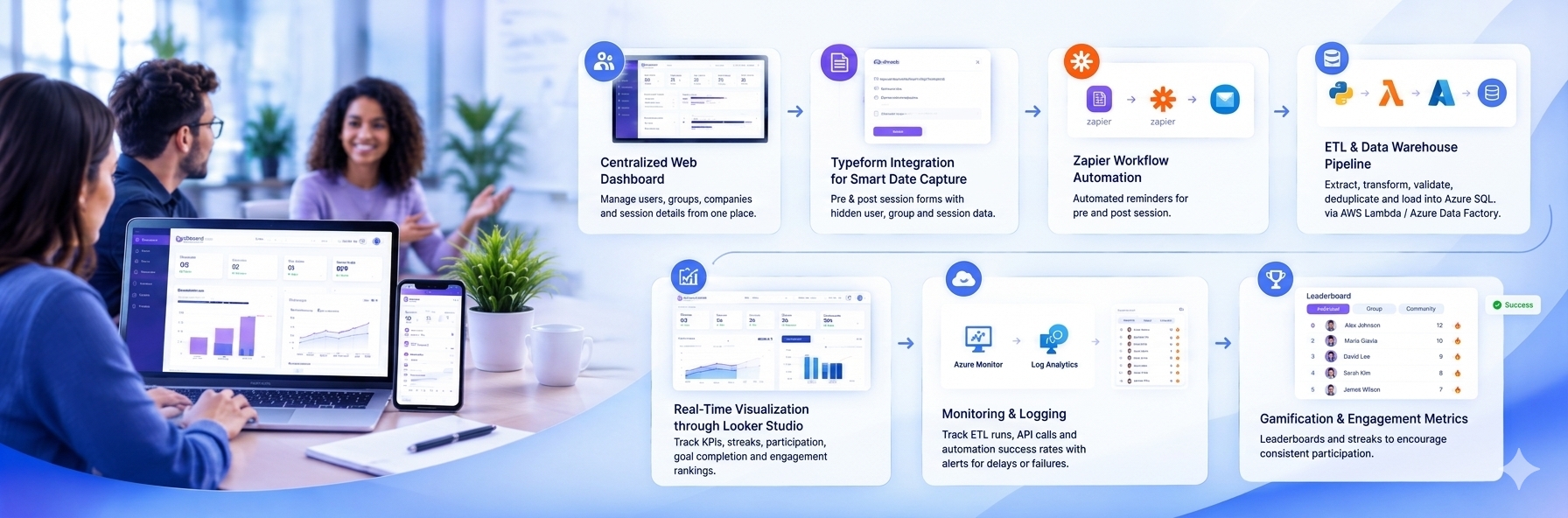
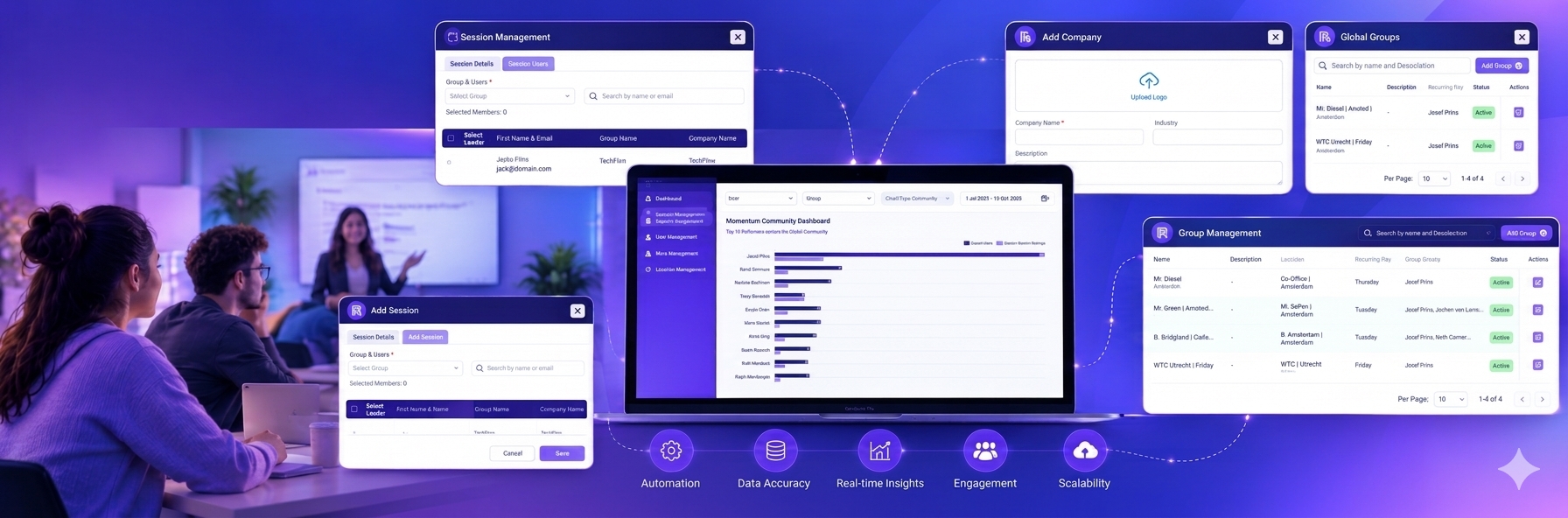
  • Centralized Web Dashboard: Built a web-based admin dashboard hosted on AWS EC2 to manage users, groups, companies, and session details from a single interface.
  • Typeform Integration for Smart Data Capture: Integrated two Typeforms for pre-session goal setting and post-session reflections, with hidden fields for user IDs, group IDs, and session metadata.
  • Zapier Workflow Automation: Implemented Zapier workflows for automated form reminders, including pre-session reminders and post-session review triggers.
  • ETL & Data Warehouse Pipeline: Automated Python-based extraction, transformation, validation, deduplication, and loading into Azure SQL Database through AWS Lambda/Azure Data Factory.
  • Real-Time Visualization through Looker Studio: Configured dashboards to display individual, group, and community KPIs, including streaks, participation rates, goal completion, and engagement rankings.
  • Monitoring & Logging: Implemented Azure Monitor and Log Analytics to track ETL runs, API calls, and automation success rates, with alerts for workflow delays or failures.
  • Gamification & Engagement Metrics: Implemented leaderboards and streak visualizations to provide real-time feedback and encourage consistent participation.
technologies & RESOURCES

Duration

6 Months

Resources

7 Tech Experts

Key features

Super Admin

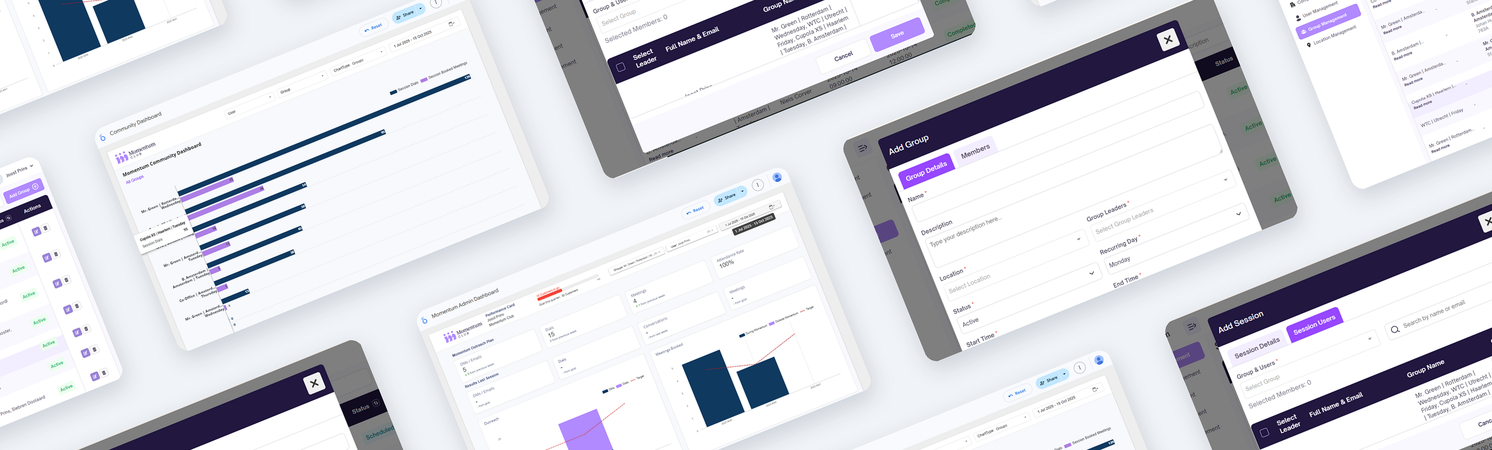
  • Company Management: The admin can add new companies that users will be associated with. This section provides a complete list view of all the companies and includes an easy-to-use interface for adding new entries by simply clicking the “Add Company” option.
  • User Management: The module operates similarly, allowing the admin to manage user records. Admins can view a comprehensive list of existing users and add new ones as needed, ensuring that all user information is current and organized.
  •  Group Management: The module is used to create and manage groups consisting of multiple users. Admins can assign users to specific groups, which are then used to facilitate structured session participation and engagement.
  • Session Management: The module enables the admin to schedule sessions and assign groups to those sessions. All active users within the selected groups are automatically invited to the session, streamlining the scheduling process and ensuring coordinated participation.


Key features

End User

  • Leader / Coach can be assigned as a Session Coach or Group Coach for individual sessions or groups.
  • Member / Founder can confirm attendance, submit pre-session forms covering lead-list preparation, quarterly goal progress, and outreach goals, and set weekly meeting and outreach targets.
  • Member / Founder can submit post-session updates covering outreach results, goal achievement, challenges, and wins, and record additional meetings booked.
  • Member / Founder can view attendance count, attendance rate, preparation rate, and attendance streaks, and track quarterly and yearly goal progress.
  • Member / Founder can monitor dials, phone conversations, DMs, emails, and meetings, and compare planned activities with actual results.
  • Member / Founder can view performance scores, leaderboard positions, and category rankings, and review personal challenges, wins, and performance history.
Business Impact

Chapter247 was responsible for the entire front- and backend development which proved instrumental in the project’s overall success.

  • Operational Efficiency Boost: Manual data entry and coordination efforts reduced drastically, improving turnaround times.
  • Data-Driven Decision-Making: Founders can now analyze trends and outcomes instantly, enabling faster, informed decisions.
  • Scalable Community Model: The automation system allows onboarding of new groups without adding administrative overhead.
  • Improved Transparency & Motivation: Real-time visibility through dashboards fostered a culture of accountability and achievement.
  • Enhanced Collaboration: Leaders can view individual and group metrics, facilitating targeted mentorship and feedback.
  • Cost Optimization: Reduced reliance on manual reporting tools minimized operational costs.
  • Future-Ready Framework: The architecture supports future AI-driven insights and expanded community engagement tools.

User Interface & User Experience

Let’s Talk About Your Idea

Share your business idea and we ensure you would embrace associating with
us.

Clients Speak

Loading reviews...


Chapter247
Privacy Overview

This website uses cookies so that we can provide you with the best user experience possible. Cookie information is stored in your browser and performs functions such as recognising you when you return to our website and helping our team to understand which sections of the website you find most interesting and useful.