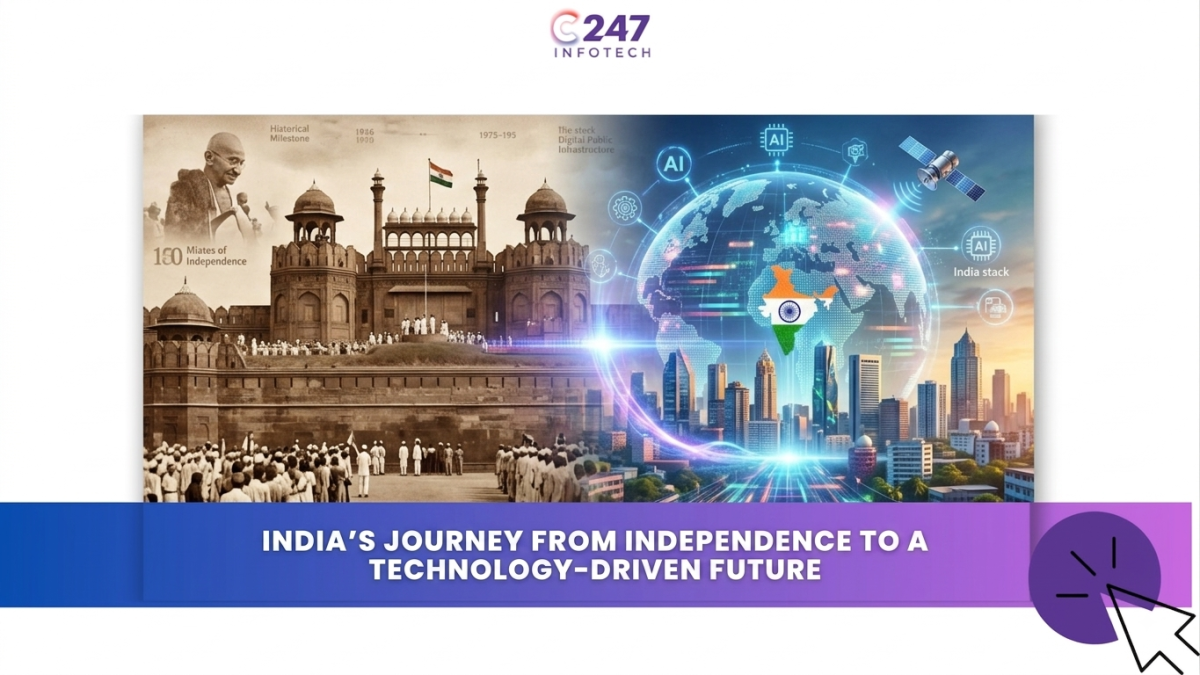
The story of India from Independence is one of resilience, scientific ambition and gradual progress. India has transformed from a broken socio-economic nation in 1947 to a globally recognized technology powerhouse through research, education, innovation and indigenous development. This is manifested in agriculture, defence, space, healthcare, digital infrastructure and sustainability today, providing a solid platform for India@100 and for hopes of tomorrow.
Building the Foundations of Scientific Progress
This is the story of how India’s technology journey started with building a nation. In the first Five-Year Plan (1951), agriculture, science, infrastructure, education and fundamental research were given greater emphasis. India improved its academic institutions, laboratories, and research centres in the coming decades and established several organizations like DRDO, Department of Space, and Department of Science and Technology. The Constitution also encouraged humanism, inquiry, and scientific temper among the citizens.
Technology Transforming Indian Agriculture
With the help of science and technology, India became more self-reliant in the field of agriculture. The Green Revolution relied on research, better varieties of wheat and rice, tractors and agricultural technology to boost production of these crops. The White Revolution was a revolution in the dairy sector, using cooperatives and innovative dairy processes with buffaloes. The Yellow, Blue and Golden Revolution, and agri-genomics are improving agricultural resilience, while edible oilseed production, fish production, honey production and horticulture has increased later.
The Rise of Indigenous Defence Technology
Indigenous technology has proven to enhance India’s strategic capability. The country has continuously enhanced its in-house expertise from the development of submarines to the development of missiles like Agni and Prithvi, the Tejas fighter, BrahMos, the INS Arihant and the INS Vikrant. This ecosystem was further enhanced by indigenous radar systems, ewar technologies, drones, anti-drone systems and advanced materials. Today, research is also focused on quantum systems, hypersonics and artificial intelligence.
India’s Journey to the Stars
India’s space programme is a result of years of bold indigenous initiatives. The beginnings were in 1975 with the journey of Aryabhata, followed by satellite communication, remote sensing, and launch-vehicle capabilities. The Mars Orbiter Mission and Chandrayaan-1 brought fame to ISRO, and India also showcased their expertise in cryogenic technology and 104 satellites being launched in one mission. The sector is still growing by private investment, new missions and innovative reusable technologies.
Science and Technology for Everyday Life
Technological advancements are not only limited to the field of electronics but have also been taken up in improving the quality of life in India. C-DOT helped to kick-start the telecom revolution, and computerised railway reservation systems showcased the real-world potential of information technology. Electronic voting machines, Aadhaar, diagnostic kits, vaccines, medical devices, etc., and low-cost water purification systems were also innovative solutions developed by the indigenous people later on. These changes led to improvements in health care and played a part in the overall increase in life expectancy, reduction in maternal mortality and infant mortality.
Healthcare Innovation with a Human Impact
Science and technology have also provided key advancements in healthcare in India. The country developed indigenous diagnostic kits, vaccines, cheap medicines, and medical devices like Sohum and NeoBreath. The introduction of biotechnology and medical research helped to increase the capacity to meet the needs of public health on a larger scale. These initiatives helped improve life expectancy and lower maternal and infant mortality, demonstrating that technology can positively impact human health.
The IT Revolution Changes India’s Global Role
The IT revolution introduced an additional big change in the life of India. The country became open to the world economy and foreign investment with the economic liberalisation of 1991, which led software services to grow rapidly. Global technology firms like Infosys, TCS and Wipro grew into the top companies in the technology world, and Indian talent became the focus of global technology operations. India grew and developed from an outsourcing hotspot to a wider innovation and entrepreneurship ecosystem.
Technology Becomes More Inclusive
Technology is now a part of India’s inclusive story. Digital India, Aadhaar, UPI, and digital payments have broadened access to digital services, ID, payment, banking, and government services. Technology has spread to individuals outside of the big cities with the growth of the internet. In parallel, the startup ecosystem in India, innovation centres and policy initiatives are driving opportunities to enable the creation of solutions for the domestic and international markets.
Preparing for India@100
India at 100 will be built upon the pillars laid as a part of the journey of the past decades. This visionary agenda is underway and includes artificial intelligence, semiconductors, drones, digitalisation, advanced manufacturing, renewable energy, hydrogen, electric vehicles and sustainable agriculture. Initiatives like Atal Innovation Mission, Deep Ocean Mission, and production-linked incentives are promoting innovation, research, entrepreneurship, and industrial development and empowering India to become more self-reliant and grow technologically.
The Road Ahead
Since 1947, India has made strides that demonstrate that technological progress does not come in isolation. It is cultivated in institutions, research, policy, indigenous innovation, skillful people, and long-term, sustained national effort. Science and Technology can play a pivotal role in addressing the challenges of complexity and enhancing its role in global competitiveness as India strives to celebrate the 100th anniversary of Independence.
Chapter247 offers businesses insight into this new technology landscape and its opportunities. m